奥村政信による浮世絵「Strolling Musician Komuso Monks」
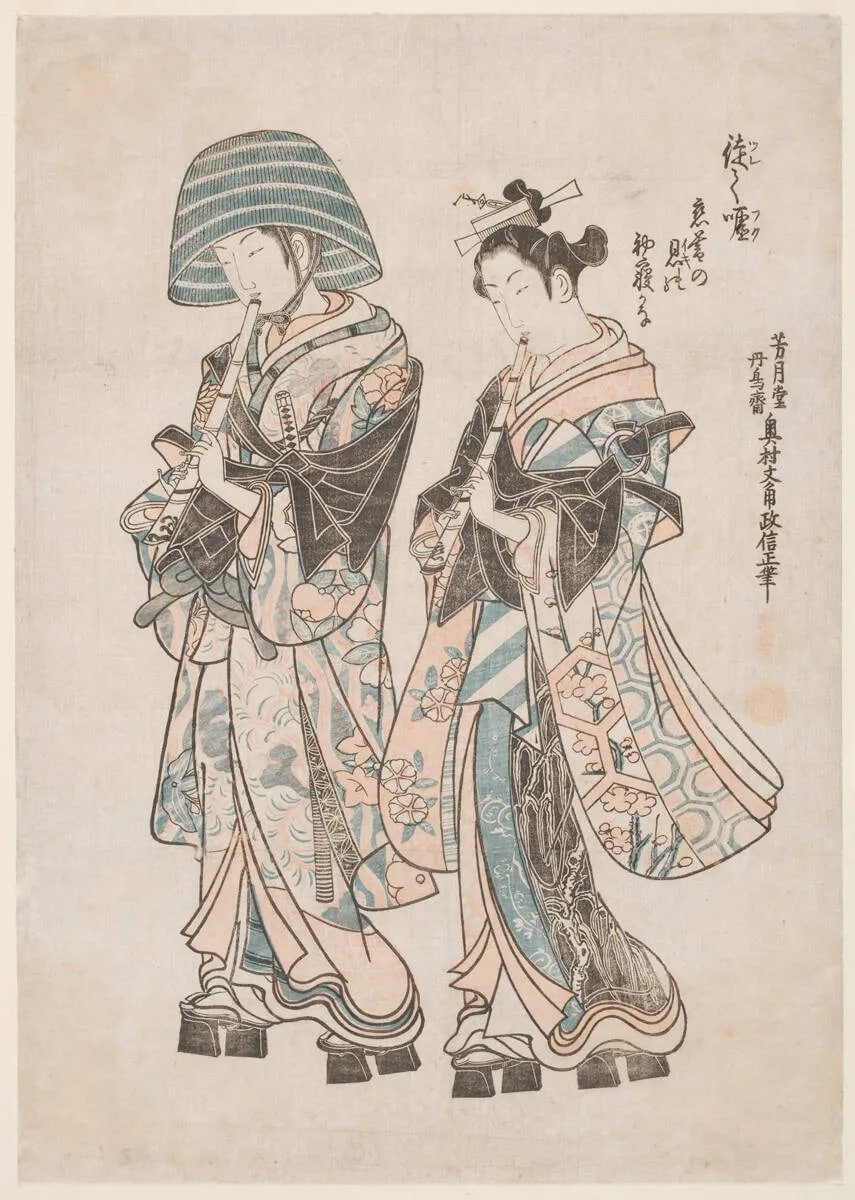
作者:奥村政信
作品名:Strolling Musician Komuso Monks
制作年:about 1750
詳細:詳細情報...
情報源:ウスター美術館
浮世絵(全 3,039 件)を表示...
説明:
In the early 750s there was a vogue for oban-format benizuri-e showing imaginary pairings of lovers or popular actors as lovers. Two lovers in disguise are depicted taking a stroll disguised as komuso. Komuso were itinerant monks of the Fuke sect of Zen Buddhism. Most were men who as a consequence of some political or other offense took refuge in temples designated as komuso-dera, thus nominally becoming Buddhist priests. Komuso were easily recognized by the accoutrements of their order These included a kesa, a black stole that hung round his neck and shoulders, a shakuhachi (flageolet) which they played as a form of meditation, and a bamboo hat known as a tengai worn to covered their head and face, presumably to screen them from temptation, when they wandered outside the temple confines. Ever since Ichikawa Danjuro II as Soga no Goro had first taken the guise of a komuso monk in a performance of 1715, this had become a regular Kabuki theater device in enabling characters to travel incognito or otherwise evade the rules of society. Resembling the less and less austere robes of destitute monks the apparel used for disguise became increasingly foppish, a deep sedge hat (tengai), a monk's stole (kesa) and shakuhachi flute acquiring the status of elegant fashion accessories. The sedge hat also became a convenient disguise for men wishing to make illicit visits to the Yoshiwara pleasure quarters. The man in this print is clearly not a true komuso monk since he exposes his face and the reference to "making music" with his companion, has erotic connotations.