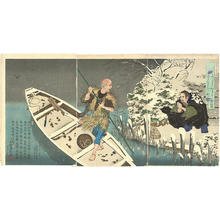
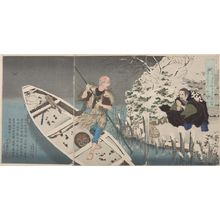
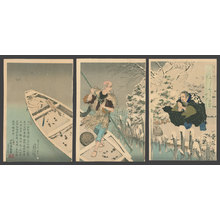
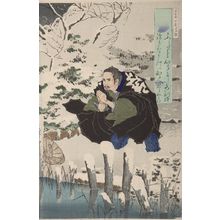
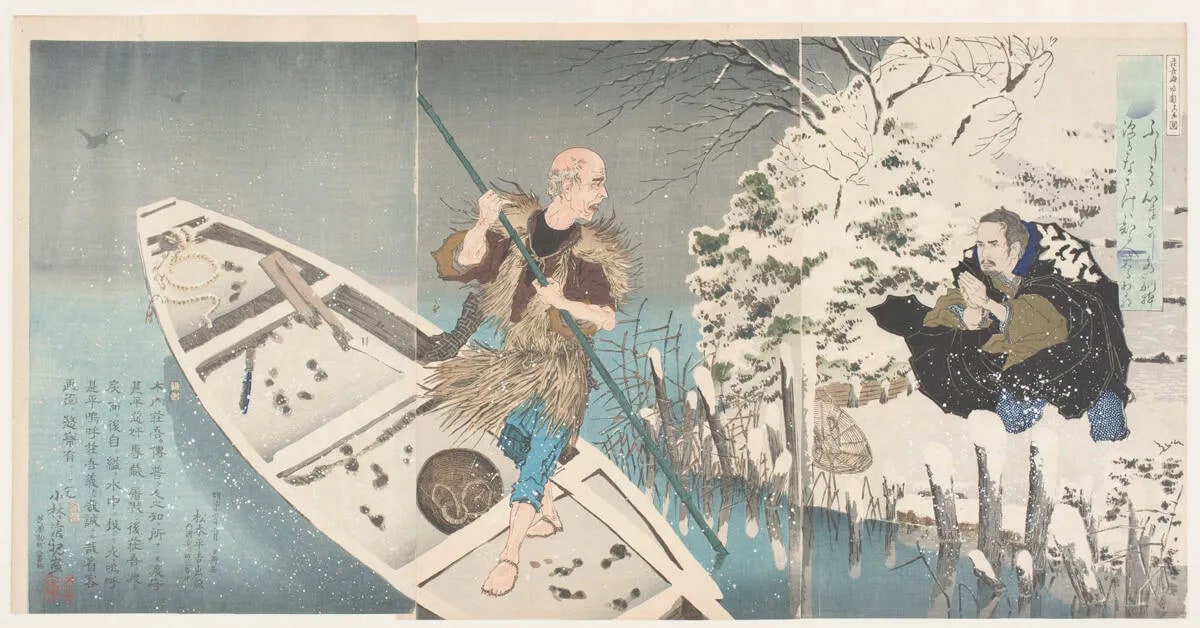
小林清親による浮世絵「Sogo at the Ferry Landing—An Authentic View (Sogo watashiba no zu—Shinga)」
作者:小林清親
作品名:Sogo at the Ferry Landing—An Authentic View (Sogo watashiba no zu—Shinga)
制作年:February 1884
詳細:詳細情報...
情報源:ウスター美術館
浮世絵(全 3,039 件)を表示...
説明:
Kiyochika often drew on history and legends as mediated by Kabuki theatre. The Story of Sogoro (or Sogo) was an historical legend that emerged during the mid-18th century and which, in 1851, was expanded into 28-act Kabuki pay (by Segawa Josai III). According to the legend Sogo was a farmer who lived in the mid-17th century in the domain of Sakura (20-odd miles east of Edo). He was crucified for leading a rebellion against the oppressive lord of the domain. Kiyochika chose to depict the most emotional; scene of the paly in this print. Sogoro, who had bravely resolved to lead a delegation of village leaders to carry the farmers' protest to Edo, wished to say his final farewell to his family in village (Kozu) on the other side of Lake Inba. Domain officials, who wanted to prevent such movement across the lake, had chained all the boats. However, a man called Jinbei, who admired Sogoro's noble cause on behalf of the farmers, used a hand axe to cut through the chain that bound his boat (see hand axe and chain in the bow of the boat). He was thus able to ferry Sogoro across the lake and back in the darkness of the snowy winter night. The moment depicted in the print is when Jinbei, now back at the point of their departure, has dropped off Sogoro and is about to leave. Filled with gratitude for Jinbei's selfless kindness, Sogoro falls to his knees and thanks him. While Sogoro then puts on his straw hat and wanders off towards Edo and a grim fate, Jinbei commits suicide by throwing himself into Lake Inba.